Thank you for meeting with a Rights Advisor today. We appreciate you taking the time to speak with us. Below is a general summary of what we discussed, with important reminders and resources for your reference. You are welcome to review this at your own pace and share it with someone you trust, if that is helpful.
1. Why was I admitted?
The Mental Health Act says a doctor or nurse practitioner can make you an involuntary patient if they examine you, and are of the opinion that you:
This means the doctor believes you are experiencing a mental health condition that affects your thinking, mood, or behaviour.
This means the doctor believes you need treatment in a hospital setting to help improve or stabilize your mental health.
This may include concerns that (a) you could harm yourself or someone else, or (b) your mental and/or physical health could get much worse if you do not receive treatment.
This means the doctor believes you may not understand or accept the need for treatment at this time.
All four of these conditions must be met at the same time for involuntary admission to continue. These decisions are based on the doctor’s medical opinion and may change as your situation changes.
2. What are my rights as an involuntary patient?
Healthcare providers must tell you your rights when you are made an involuntary patient, and on transfer or renewal. Your legal rights include the right to:
You have the right to be told the name and location of the facility in which you are being detained.
That’s us! Thank you for meeting with us.
Our role is to explain your rights, answer questions, and support you in understanding your options. You’re eligible for one Rights meeting every certification period. Tell a member of your treatment team if you want to meet with a Rights Advisor or visit the Independent Rights Advice Service website.
The doctor or nurse practitioner must clearly explain why they believe you meet all four criteria. These reasons must be written on your medical certificate (Form 4.1 or Form 4.2). If your certification is renewed, the reasons must be included on the renewal certificate (Form 6).
You have the right to know what is on your certificate. Ask a member of your treatment team to see your certificate(s) or have the contents read aloud to you. Access Form 4.1, Form 4.2, and Form 6.
A doctor must check your progress regularly. You stop being an involuntary patient as soon as a doctor determines that you no longer meet all four criteria. You have the option of continuing treatment as a voluntary patient.
If you do not agree with your mental health treatment, you can ask for another doctor to give a second opinion on your treatment. Please access Form 11.
You have the right to apply for a review panel hearing with the Mental Health Review Board. Review panels have three people who will hear your case and decide if you still meet all four criteria to be an involuntary patient. Access a copy of Form 7 and/or visit the Mental Health Review Board website.
When you apply for a hearing, you can ask for free legal help from the Mental Health Law Program. They can connect you with a legal representative to help prepare your case and represent you.
You have the right to contact a lawyer at all times. The facility must provide access to a phone and a private room to call. Learn more about eligibility for free legal aid.
There are three court processes for challenging your involuntary detention:
Judicial review: If you are not satisfied with the decision of your review panel hearing, you have the right to apply to a judge to investigate the panel’s decision for any errors of procedural fairness.
Section 33 application: You have the right to ask the court to review your doctor’s decision to keep you in the facility as an involuntary patient.
Habeas Corpus application: You have the right to apply to the court to ask a judge if your medical certificates are in order.
As with all of the court procedures, it is best that you are supported and/or represented by a lawyer.
3. Mental Health Act Forms Explained
Please note this is not an exhaustive list of all MHA forms, but rather the most commonly referenced forms. For a complete list, please visit Mental Health Act Forms.
Form 4.1: First Medical Certificate
Certifies a patient as involuntary for up to 48 hours as part of the initial assessment. View Form 4.1 PDF
Form 4.2: First Medical Certificate
This renews your involuntary status up to one month. View Form 4.2 PDF
Form 6: Renewal Certificate
Renews involuntary admission for certification periods of one month, three months, or six months. View Form 6 PDF
Form 7: Application to Review Panel
Challenge your involuntary certification with an independent Review Panel. View Form 7 PDF
Form 11: Request for Second Medical Opinion
Request another physician to review your treatment and give a second opinion. View Form 11 PDF
Form 13: Rights Notification
This explains your legal rights if you are involuntarily admitted. You should receive this form upon certification as an involuntary patient. View Form 13 PDF
Form 15: Nomination of Near Relative
This form allows you to choose which relative will be notified of your admission, review panel hearing, and/or discharge. View Form 15 PDF
Form 20: Extended Leave Authorization
Authorizes temporary leave from the hospital while still under the Act. View Form 20 PDF
Form 22: Request for Rights Advice
You can use this to ask to speak with a rights advisor about your legal rights. Ask your treatment team for a copy. View Form 22 PDF
Form 5: Consent for Treatment
Documents treatment authorization while you are involuntary. View Form 5 PDF
Form 12: Medical Report (Second Medical Opinion)
The written findings from the second doctor who reviewed your treatment. View Form 12 PDF
Form 16.1: Notification to Near Relative
Confirms that a patient’s near relative has been notified of an involuntary admission. View Form 16.1 PDF
Form 19: Certificate of Discharge
Confirms the discharge of a patient from involuntary status. View Form 19 PDF
Frequently Asked Questions
These are some of the most common questions people ask while admitted under the Mental Health Act.
Rights Advisors provide an independent and confidential service. Our role is to provide you with legal information about your rights under British Columbia’s Mental Health Act and to support you in understanding your options.
As we are not part of your treatment team, we are uninvolved in decisions regarding your involuntary certification. This means we are not involved in your involuntary admission, psychiatric treatment or matters related to your discharge.
Under British Columbia’s Mental Health Act, if you are certified as an involuntary patient, psychiatric treatment for your mental disorder can be provided without your consent. You still have the right to ask questions about the medication, including what it is for, the benefits, and possible side effects. You retain the right to refuse and/or consent to non-psychiatric medication.
Remember, that it is also your legal right to request a second medical opinion by submitting Form 11. Treatment must be medically appropriate and connected to your mental disorder. Your concerns and experiences matter, and you are entitled to be treated with dignity and respect.
Learn more about treatment decisions.
Voluntary admission refers to an individual that has willingly sought psychiatric treatment for their mental illness at a healthcare facility. Voluntary patients retain their legal right to refuse/consent to psychiatric medication and request to be discharged from the healthcare facility.
Involuntary admission occurs when a doctor or nurse practitioner determines that an individual meets all (4) of the involuntary admission criteria required for certification as an involuntary patient. When admitted as an involuntary patient, patients cannot refuse psychiatric treatment or leave the hospital without authorization while they are certified.
However, being involuntary does not mean losing all rights. Involuntary patients still have important legal protections.
Being in hospital involuntarily can feel confusing and overwhelming. Under the Mental Health Act, you can be kept in hospital for as long as a doctor believes you continue to meet the admission criteria.
In some cases, your care may continue outside the hospital on an outpatient basis through something called extended leave. This means a doctor believes you still meet all of the involuntary admission criteria, but that your treatment may be better supported in a community setting.
There are set timeframes for review (see this diagram), and you have the right to be reassessed regularly. You must be discharged from involuntary status as soon as a doctor determines that you no longer meet all four criteria.
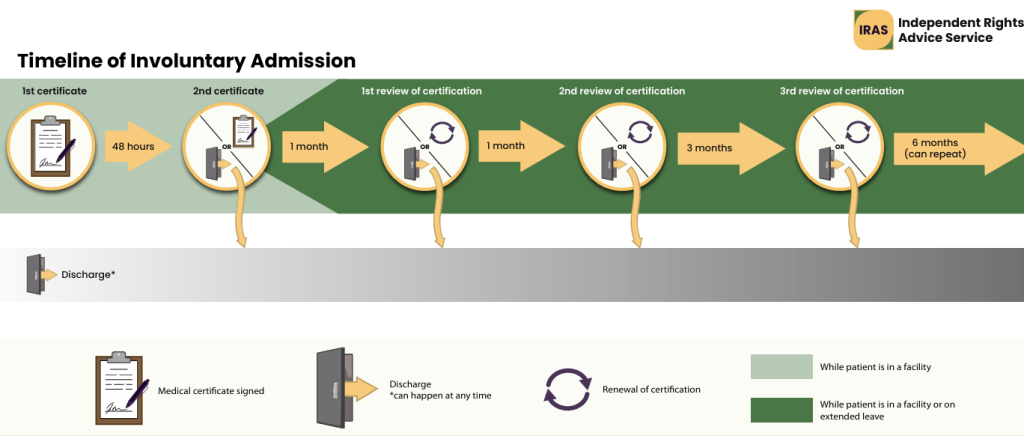
Decisions about whether you continue to meet the criteria are made by medical professionals. A doctor or nurse practitioner can complete the initial Form 4.1. For the remaining certification periods, only a doctor can reassess you and decide whether to renew your involuntary status.
As an an involuntary patient, you have the right to ask questions and be involved in your treatment plan. If you disagree with your detention status as you believe you do not meet all four of the involuntary admission criteria, you have the right to apply for a review panel hearing (Form 7). You also have the right to speak with a lawyer at any time.
If you are an involuntary patient, You cannot leave the hospital without authorization (i.e. passess) while you are certified. If you are interested in the possibility of being an involuntary patient in community, please ask your treatment team about Extended Leave (EL).
• Extended Leave (Form 17 – Leave Authorization)
Your doctor may authorize you to live in the community under specific conditions (i.e. attending appointments or taking medication). This is referred to as ‘extended leave.’ On extended leave, you are still legally certified, but you are living in the community as an out-patient instead of being an in-patient in hospital.
EL patients are now able to book a Rights Advice meeting directly through our IRAS booking Portal
Nomination and Notification of a Near Relative (Form 15 and 16) If you are admitted involuntarily, the hospital must notify a “near relative” that you have been admitted. Completing a Form 15: Nomination of Near Relative allows you to choose which relative you would like to be notified about your admission, review panel hearing, and/or discharge status. The hospital will then submit a Form 16: Notification to a Near Relative to notify a near relative of your admission and other important updates, as is required under the Mental Health Act This notification typically confirms that you have been admitted and the name of the hospital. It does not automatically mean detailed medical information will be shared.
It’s common to feel anxious about who knows what. You have a voice in this. While the hospital has a legal duty to notify a near relative of an involuntary admission, your broader medical information remains protected. If family involvement feels supportive, staff can help include them. If it feels unsafe or unwanted, you can raise those concerns and ask about your options.
Contacts
Interested in Learning More?
Thank you again for meeting with a Rights Advisor today. We know this can be a challenging time, and we hope the information provided helps you understand your rights and next steps.